In a quiet classroom in Nyagatare District, a group of students watch in awe as their teacher connects them to another school hundreds of kilometers away in Rusizi. Within seconds, the two classes are exchanging ideas through a live virtual lesson — all powered by high-speed internet and smart classroom technology.
This moment, once unthinkable in many parts of rural Rwanda, is now becoming the new normal. Thanks to a bold government initiative known as “Smart Education Phase II,” over 2,500 schools across the country are set to be digitally connected in the coming months — linking teachers, students, and resources like never before.
The project marks a new chapter in Rwanda’s digital transformation journey, one that aims to ensure that no learner, no matter how remote their school may be, is left behind in the digital age.
Rwanda’s Smart Education programme is not new — it’s part of a long-term vision that started years ago under the country’s goal of building a knowledge-based economy.
During Phase I, about 1,500 schools were connected to the internet, and two national data centres were established to support educational content, e-learning platforms, and online administrative systems. That groundwork created a digital foundation for what’s now being scaled up to national level.
The new phase, launched in October 2025, expands the network to reach 2,500 more schools, bringing total coverage to about 4,000 schools — a massive leap toward universal digital access in education.
The project is being implemented in partnership with Huawei Technologies, one of the world’s leading ICT providers. Financing comes through a concessional loan arranged by the China International Development Cooperation Agency, continuing the strong cooperation between Rwanda and China in digital infrastructure.
The initiative will:
-
Connect 2,500 schools to high-speed internet.
-
Establish 100 smart classrooms equipped with interactive whiteboards, projectors, and networked devices.
-
Create a National Education Cloud Platform — a secure, centralized system where schools can share digital learning materials, lesson plans, and administrative data.
This system is designed to be the backbone of Rwanda’s future learning environment. Instead of relying on physical textbooks, teachers and students will be able to access materials directly from the cloud.

The Smart Classroom Experience
Smart classrooms are much more than computer labs. Each one is designed to be an interactive, multimedia learning environment where students can collaborate in real time with peers across different districts — or even with international partners.
During the project’s demonstration sessions, students from Kagarama Secondary School in Kigali held live virtual classes with learners at G.S. Rwimiyaga in Nyagatare, College Saint André in Nyarugenge, and Gihundwe Secondary School in Rusizi.
For many students, this was their first experience of seeing technology break the barriers of distance.
“It’s like the whole country has become one big classroom,” said one student participant. “We can share ideas instantly, and teachers can show us things online that were never in our books.”
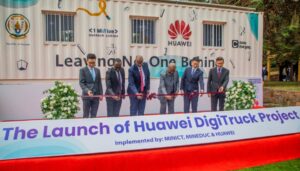
Alongside the Smart Education rollout, the government has introduced another innovative project: the DigiTruck.
The DigiTruck is a solar-powered mobile classroom built inside a large container truck. It travels from district to district carrying laptops, routers, and training materials, bringing digital literacy to people who have never touched a computer before — especially youth, women, and farmers.
Inside, learners are trained on basic computer use, internet navigation, cybersecurity, and digital entrepreneurship.
This approach ensures that Rwanda’s digital revolution is not limited to formal schools. As officials have emphasized, true digital transformation must include everyone — even those outside the traditional education system.
Linking with Rwanda’s National Vision
The Smart Education programme is a key component of Rwanda’s National Strategy for Transformation (NST2).
NST2 sets ambitious goals: to train over one million citizens in digital skills, make public services available online, and position Rwanda as a hub for innovation in Africa.
By transforming classrooms into digital spaces, Rwanda is not just modernizing its education system — it’s laying the foundation for the country’s future economy.
“Our aim is to make every Rwandan digitally literate,” said a senior official from the Ministry of Education. “We want to prepare a generation that will not only use technology but also create with it.”
Why Digital Education Matters
In today’s world, technology is no longer a luxury — it’s a basic necessity. Schools without internet access are at a huge disadvantage, unable to tap into the wealth of online knowledge, tools, and global collaborations that define 21st-century education.
The Smart Education initiative helps address this imbalance by:
-
Equalizing access: Rural schools will now have the same digital opportunities as urban ones.
-
Empowering teachers: Educators gain access to online professional development, teaching aids, and collaboration platforms.
-
Enhancing learning: Interactive and multimedia tools can make learning more engaging, practical, and fun.
-
Improving administration: Digital attendance systems, data management, and resource sharing streamline operations.
For Rwanda — a small, landlocked country with big ambitions — digital education is not just about teaching children to use computers. It’s about shaping a generation that can compete globally, innovate locally, and lead Africa into a digital future.
Addressing Teachers’ Concerns
Not everyone has been immediately comfortable with the idea of digital classrooms. Some teachers have quietly worried that virtual teaching could make them obsolete — that one teacher might teach hundreds of classes online, reducing the need for more educators.
Officials have been quick to address those concerns.
According to the Chief Digital Officer at the Ministry of Education, the purpose of Smart Education is not to replace teachers, but to empower them.
Technology, he explained, will allow teachers to collaborate, share content, and learn from one another. It creates a network of support, not a competition.
In fact, the new system includes online training modules where teachers can upgrade their digital and pedagogical skills — ensuring they remain at the center of Rwanda’s education transformation.
Learning from Phase One
Phase I of Smart Education provided valuable lessons. Some schools faced challenges such as unstable electricity, slow connectivity, or limited computer literacy among teachers.
This time, the government is addressing those gaps through:
-
Training programs for teachers before installation.
-
Improved infrastructure, including solar energy systems in off-grid schools.
-
Maintenance plans to ensure long-term sustainability.
-
Local technical support, so schools don’t depend solely on external experts.
As a result, Phase II is expected to run more smoothly, with lessons learned from the past shaping better outcomes for the future.
For many teachers, Smart Education represents a long-awaited opportunity.
“I used to walk several kilometers just to print lesson plans or find internet access,” says Grace Mukamana, a teacher in the Western Province. “Now I can prepare my lessons online, share them with my colleagues, and even attend workshops without leaving my classroom.”
Students are equally enthusiastic. At G.S. Marie Merci Kibeho in the Southern Province, learners describe feeling “connected to the world.” They can now access videos, interactive science experiments, and global virtual libraries — resources that were unimaginable a few years ago.
Parents, too, are beginning to see the benefits. Through digital tools, they receive updates on attendance, school performance, and even tuition reminders directly to their phones.
Global Partnerships and Local Innovation
Rwanda’s partnership with Huawei is central to the Smart Education project. The Chinese tech giant has provided not only hardware and connectivity solutions but also training for local technicians and teachers.
Still, Rwandan experts stress that the project’s real success depends on local ownership. The government has been encouraging Rwandan software developers, education specialists, and ICT students to create homegrown digital content — in English, Kinyarwanda, and French — that reflects local culture and learning needs.
This blend of global technology and local innovation could make Rwanda a model for other African nations seeking to modernize their education systems sustainably.
Challenges Ahead
Despite its promise, Smart Education faces a number of challenges:
-
Connectivity Gaps – Some rural areas still lack reliable internet or electricity. The use of solar power and mobile networks is expected to help, but it will take time.
-
Maintenance Costs – Once the equipment is installed, schools must maintain it. Without local technicians or adequate budgets, systems could deteriorate.
-
Teacher Training – Not all teachers are digitally confident. Continuous professional development will be crucial to prevent the technology from becoming underused.
-
Data Privacy and Security – As schools move online, protecting student and teacher data becomes essential. Rwanda’s data protection policies will need to evolve with the system.
-
Financial Sustainability – While concessional loans make the project affordable now, long-term costs — especially for software updates, hardware replacement, and cloud hosting — must be planned carefully.
Nevertheless, the government insists these are challenges to be managed, not feared.
“Innovation always comes with difficulties,” said one official. “But if we stop because of challenges, we would never progress. Our goal is to learn, adapt, and move forward together.”
Beyond classrooms, the Smart Education initiative could have far-reaching effects on Rwanda’s digital economy. By exposing millions of young people to technology early, the country is effectively building a pipeline of future innovators.
Students who learn coding, data analysis, or digital design in secondary school will enter universities and industries already equipped with essential skills.
This aligns with Rwanda’s broader ambition to become the ICT hub of Africa — hosting international conferences, tech startups, and innovation hubs such as the Kigali Innovation City.
International observers are closely watching Rwanda’s model. Many developing countries face similar challenges: large rural populations, limited resources, and a growing digital divide.
By using smart partnerships, creative financing, and mobile solutions like the DigiTruck, Rwanda demonstrates that digital inclusion in education is possible even with limited means.
In the words of one education expert:
“Rwanda is showing that transformation doesn’t start with wealth; it starts with vision and willpower.”
The government’s goal is to have every school connected within the next few years, ensuring that no student grows up digitally excluded.
As this second phase unfolds, monitoring and evaluation will be key. The Ministry of Education plans to track not only how many schools are connected but how effectively technology is being used for learning outcomes — from test results to student engagement.
If successful, Rwanda’s Smart Education programme could become a blueprint for Africa — proving that even small nations can leapfrog into the digital era through determination, innovation, and inclusiveness.
In the span of a generation, Rwanda’s classrooms are transforming from chalkboards to cloud-based learning hubs.
The journey hasn’t been easy — it’s taken years of planning, investment, and belief. But with 2,500 more schools now joining the digital network, Rwanda is taking another major step toward its dream of a connected, empowered, and knowledge-driven nation.
As one young student in the Northern Province put it, smiling after a live online lesson:
“Before, the world felt far away. Now, it’s right here in our classroom.”