 n
n
In a world where technology is transforming the way we learn and work, a groundbreaking invention by a young Chinese student is making global headlines. The innovation
a sleek, intelligent AI-powered pen is said to solve even the most complex mathematical equations in the blink of an eye. Nicknamed by early reviewers as “the bullet pen” for its unparalleled speed, this device could reshape the way students, teachers, engineers, and researchers approach mathematics.
This is not just another smart gadget. It represents a leap forward in artificial intelligence (AI) integration with everyday educational tools, blurring the lines between human learning and machine-driven problem solving.
The Student Behind the Invention
At the heart of this invention is Liang Chen, a 21-year-old undergraduate engineering student at Tsinghua University, one of China’s most prestigious institutions. Liang grew up fascinated by puzzles and numbers. According to his professors, he was not only talented in mathematics but also deeply passionate about using technology to solve practical problems.
The idea for the AI pen was born out of Liang’s personal frustration. “I loved mathematics, but I realized that many of my classmates struggled with equations not because they lacked intelligence, but because solving them step by step consumed too much time,” he explained in an interview. “I wanted to create something that would remove that burden and allow people to focus on understanding concepts instead of getting stuck in calculations.”
With limited resources but immense determination, Liang started designing prototypes in his dormitory room. His project soon attracted attention when he won a regional student innovation contest, earning small grants and mentorship from leading AI researchers.
How the AI Pen Works
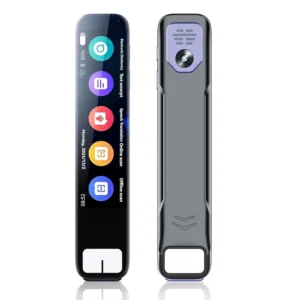
At first glance, the AI pen looks like an ordinary digital stylus. But inside its slim body lies a sophisticated miniature AI processor, a high-resolution camera, and advanced machine learning algorithms.
Here’s how it works:
- Equation Recognition The pen has a tiny embedded camera that scans the written equation. Unlike traditional OCR (Optical Character Recognition), this pen uses neural network-based vision systems capable of recognizing mathematical notations in real time, whether handwritten or printed.
- AI Calculation Engine – Once scanned, the AI engine instantly processes the equation using advanced symbolic mathematics algorithms. It doesn’t just compute numerical results—it can also handle algebra, calculus, trigonometry, and even differential equations.
- Step-by-Step Solution – The most impressive feature is that the pen doesn’t merely give the final answer. It breaks down the steps logically, almost like a private tutor, ensuring that students can learn rather than just copy results.
- Voice and Screen Output – The pen is fitted with a small OLED screen and voice assistant. It can display solutions or read them aloud, making it useful for students with different learning styles, including those with visual impairments.
Liang describes the pen’s processing speed as “faster than a bullet.” While the phrase is symbolic, demonstrations show that even complex multi-variable equations are solved in less than half a second.
Education Experts React
The invention has sparked lively debates among education experts worldwide.
Dr. Mei Huang, an educational technology researcher at Beijing Normal University, hailed the invention as “a breakthrough that can democratize learning.” She noted:
“For centuries, learning mathematics required long hours of repetitive problem-solving. This pen can reduce the mechanical workload, allowing students to focus on critical thinking, creativity, and application of knowledge.”
However, not all experts are enthusiastic. Some educators worry it may lead to overreliance on technology. Professor David Ross, a mathematician at Oxford University, expressed caution:
“Mathematics is not just about finding answers it’s about the journey of logical reasoning. If students skip the journey entirely, they may lose the ability to think critically. The key question is whether this tool will be used responsibly.”
Potential Benefits
The AI pen could have far-reaching implications:
- In Classrooms – Teachers could integrate it as a supportive tool. Instead of spending hours on routine drills, students could verify answers quickly and spend more time discussing concepts.
- For Struggling Students – Learners who often give up due to frustration with complex steps may regain confidence and interest in mathematics.
- For Advanced Learners – The pen can solve higher-level problems, helping university students and researchers check their work instantly.
- Beyond Education – Industries that rely heavily on calculations, such as engineering, finance, and data science, could use it for rapid verification of complex computations.
- Accessibility – With its voice assistant feature, visually impaired students could engage with mathematics in ways previously unavailable to them.
The invention comes at a time when AI-powered educational tools are booming. Smart calculators, apps like Photomath, and AI tutors have already gained millions of users. However, what makes Liang’s pen different is its physical integration into a writing tool, combining the familiarity of pen-and-paper learning with cutting-edge AI assistance.
International media outlets have compared it to the early days of the electronic calculator in the 1970s. Back then, calculators were controversial too—some educators feared they would destroy mathematical learning. Yet today, calculators are seen as essential.
Could Liang’s AI pen follow a similar path? Many believe so.
Despite its promise, several challenges lie ahead:
- Ethical Concerns – Will students misuse the pen to cheat during exams? Liang himself admits this is a real risk. He suggests that strict classroom regulations and special “exam-safe” modes could be developed.
- Affordability – Advanced AI hardware is not cheap. If the pen becomes too expensive, it might widen the gap between privileged and underprivileged students. Liang says his dream is to make it affordable for every student, not just the wealthy.
- Dependence on AI – Psychologists warn that over-dependence on AI tools may reduce problem-solving stamina among young learners.
- Accuracy and Trust – While initial tests show remarkable accuracy, no AI system is flawless. A single miscalculation could have serious consequences in fields like engineering or medicine.
Currently, the AI pen exists in prototype form. Liang Chen, with support from Tsinghua University, has filed for intellectual property patents. Several Chinese tech companies have reportedly expressed interest in partnering with him for mass production.
If commercialized, the AI pen could launch in China within two years, followed by international markets. Liang envisions not only individual sales but also institutional partnerships with schools and universities.
He is also working on a cloud integration feature that would allow pens to update themselves with new mathematical models, keeping pace with evolving education needs.
Liang’s AI pen is more than just a gadget it symbolizes the larger wave of AI in education. From chatbots that help students write essays to personalized learning platforms that adapt to each learner’s strengths and weaknesses, AI is rapidly transforming classrooms.
Supporters argue that AI frees humans from repetitive tasks, enabling deeper intellectual engagement. Critics, however, warn that the erosion of basic skills could harm long-term human capacity.
In this context, the AI pen sits at the center of an urgent question: Should technology make learning easier, or should it preserve challenges as part of the educational process?
Unsurprisingly, many students are excited. Social media in China has exploded with videos of the prototype demonstration. One high school student commented:
“If I had this pen during my final exams, I would never have stayed up all night worrying about algebra.”
Another said:
“This pen doesn’t just solve it explains. It’s like having a teacher in your pocket.”
However, some students admitted they feared they might become “lazy” and forget how to solve equations on their own.
The future of the AI pen depends on how stakeholders—educators, policymakers, companies, and students—choose to use it. If embraced wisely, it could revolutionize education, making learning more inclusive and efficient. If misused, it could undermine fundamental skills.
Liang Chen remains optimistic. “Technology is a tool,” he says. “A hammer can build a house or break it. My hope is that this pen builds a future where no student feels afraid of mathematics.”
The story of a young Chinese student creating an AI pen that solves equations “as fast as a bullet” is not just about speed. It is about the ongoing transformation of education through technology, the balance between human reasoning and machine efficiency, and the dreams of a new generation of innovators.
As this invention moves closer to commercialization, it raises profound questions: Will it be the calculator of the 21st century or a crutch that weakens critical thinking? Time—and the choices society makes—will determine its legacy.
For now, Liang Chen’s AI pen stands as a symbol of youthful ingenuity, a product of curiosity and persistence that may well change the way the world learns mathematics.