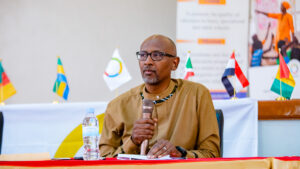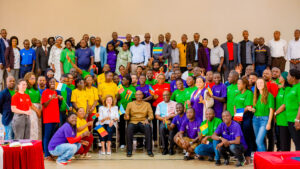
On 5 October 2025, Rwanda’s Minister of Education, Hon. Joseph Nsengimana, officially welcomed a new cohort of 50 teacher-volunteers from the Organisation Internationale de la Francophonie (OIF). These educators will spend the academic year working across Teacher Training Colleges (TTCs) and schools to enhance the quality of French language instruction and support the country’s broader multilingual education agenda.
This latest initiative reinforces Rwanda’s long-term commitment to linguistic diversity and international cooperation, aligning with its vision to strengthen French proficiency while maintaining a balance among the country’s official and working languages.
Rwanda’s language policy has evolved significantly over the past two decades. Kinyarwanda remains the national language, while English, French, and Swahili serve as official or working languages. The 2008 policy shift designating English as the medium of instruction marked a turning point, reflecting Rwanda’s drive for global competitiveness and integration into the East African Community and Commonwealth.
Nonetheless, French has retained importance in diplomacy, culture, and Francophonie cooperation. The government now promotes a plurilingual approach that views multilingualism not as a cultural luxury but as a strategic necessity for quality education and international engagement.
To that end, the Plan National pour l’Enseignement et l’Apprentissage du Français au Rwanda (PNFR) is being developed to reinforce French instruction through updated curricula, teacher training, and modern pedagogical methods. The plan is jointly supported by OIF, the Agence Française de Développement (AFD), and the Agence Universitaire de la Francophonie (AUF).
The OIF Teacher-Volunteers Program
Launched in 2020 by the Francophonie Secretariat, the Projet de mobilité des enseignantes et enseignants de et en français aims to enhance the teaching of French and teaching in French in partner countries. It also focuses on building local teacher capacity through mentorship, collaborative training, and exposure to contemporary teaching methodologies.
The program’s goals are multifaceted: improving the quality of French instruction, strengthening TTCs as centers of pedagogical excellence, and enriching school life through French clubs and cultural activities.
Since its inception, the initiative has deployed multiple cohorts to Rwanda. The first, in 2020, brought around 20 teachers, followed by a second cohort of about 45 volunteers from over 15 Francophone nations. Each group underwent orientation sessions to familiarize themselves with Rwanda’s educational context and teaching standards.
Evaluations of previous phases revealed positive outcomes—improved student proficiency in French, increased teacher confidence, and vibrant extracurricular engagement. Schools hosting volunteers reported revived enthusiasm for French through debates, poetry contests, and cultural exchanges.
The newly arrived group of 50 OIF volunteers marks the largest intake since the program began. Drawn from approximately 15 Francophone countries, the volunteers will serve primarily in TTCs and selected primary and secondary schools. Their mission is to train and mentor Rwandan teachers, support curriculum delivery, and promote French through interactive and cultural learning activities.
Before deployment, the volunteers participated in orientation workshops covering Rwanda’s education system, language policy, and intercultural communication. Their work is expected to reinforce ongoing capacity-building efforts and contribute to improved learning outcomes.
Minister Nsengimana emphasized that the program “has become a cornerstone of Rwanda’s strategy to strengthen multilingual education,” highlighting that French instruction complements rather than competes with English. “Multilingualism,” he noted, “broadens opportunities for our students and enhances Rwanda’s engagement with both the Anglophone and Francophone worlds.”
Rwanda’s collaboration with OIF is backed by a strong network of partners. The Agence Française de Développement (AFD) has provided financial support—estimated at around €5 million—to coordinate and monitor the national French teaching plan. AUF contributes through initiatives such as FLE Rwanda, which trains hundreds of teachers and education inspectors in modern methodologies.
These partnerships ensure that Rwanda’s multilingual education policy is both technically supported and sustainably funded. They also align the country’s education reforms with international standards and strengthen its visibility within the Francophonie community.
The impact of earlier OIF cohorts is already visible in schools and TTCs across the country.
-
Improved Student Proficiency: Learners demonstrate stronger speaking, writing, and comprehension skills in French. Many schools have revived French clubs, debates, and competitions, increasing student engagement.
-
Teacher Development: Local teachers report greater confidence and improved techniques, having adopted communicative and learner-centered approaches introduced by the volunteers.
-
Institutional Strengthening: TTCs now serve as better-equipped training centers, producing educators capable of teaching in or through French.
-
Cultural Revitalization: The program has rekindled appreciation for French as a language of culture, diplomacy, and opportunity.
Despite the progress, Rwanda’s efforts to reinforce French instruction face several challenges. Many students, especially in rural areas, begin secondary education with weak foundations in French. Local teachers sometimes lack exposure to up-to-date teaching methods or materials, making sustained mentorship essential.
Since English remains the official medium of instruction, balancing both languages requires policy clarity and consistent resource allocation. Schools need modern textbooks, digital tools, and audiovisual materials to make language learning more effective.
Ensuring sustainability is another priority. Over time, Rwanda aims to reduce reliance on foreign volunteers by strengthening local teacher training, embedding multilingual pedagogy into TTC programs, and allocating national budgets for language education.
The 2025 cohort arrives at a pivotal moment. Rwanda is transitioning from pilot initiatives to broader, systemic integration of French language instruction. The volunteers’ presence will not only strengthen TTCs—the breeding ground for future educators—but also help refine and scale up practices identified as effective in earlier phases.
Their work symbolizes Rwanda’s continued confidence in international collaboration and its readiness to play an active role in the global Francophonie network. By reinforcing linguistic diversity, Rwanda projects itself as a bridge between Francophone and Anglophone spheres in Africa and beyond.
Maximizing the Program’s Impact
Experts suggest several strategies to ensure the program’s long-term success:
-
Continuous professional development for volunteers and local teachers throughout the year.
-
Regular monitoring and evaluation of student performance and teaching practices.
-
Clear curriculum alignment and language-use guidelines across education levels.
-
Provision of adequate teaching resources, including digital platforms and interactive tools.
-
Expansion of extracurricular activities and community outreach in French.
-
Incentives and recognition for local teachers who excel in French instruction.
-
Institutionalizing the program through TTCs and universities to ensure sustainability.
Teachers and students in schools hosting OIF volunteers describe noticeable transformations. Classrooms have become more interactive, and students display newfound confidence in using French during lessons and public speaking events.
Volunteer educators, on the other hand, emphasize the mutual learning experience—discovering Rwanda’s educational innovations and the resilience of its multilingual students. TTC administrators credit the volunteers for revitalizing teacher training and modeling effective French teaching practices.
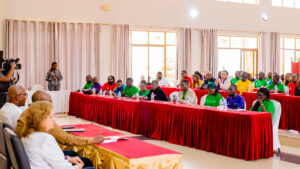
The initiative’s benefits extend far beyond classrooms. It strengthens Rwanda’s diplomatic and cultural ties within the Francophonie community, fosters cross-border collaboration, and opens economic opportunities linked to tourism, trade, and international employment.
Research also shows that multilingual education enhances cognitive flexibility and academic performance, providing students with valuable skills for a competitive global market. Importantly, Rwanda’s approach underscores that reinforcing French does not undermine Kinyarwanda or English; instead, it enriches national identity and global connectivity.
The arrival of the new OIF teacher-volunteer cohort marks another milestone in Rwanda’s pursuit of a dynamic, multilingual education system. With strong partnerships, strategic leadership, and growing local ownership, the country is steadily transforming how French is taught and learned.
Minister Joseph Nsengimana captured this vision succinctly during the welcoming ceremony:
“Through collaboration with the Francophonie, Rwanda has gained not only skilled teachers but renewed enthusiasm and confidence among students and educators alike.”
That renewed confidence—expressed in classrooms, TTCs, and communities across the country—may well be the most enduring legacy of Rwanda’s commitment to Francophonie and multilingual excellence.